Best Salary Sacrifice Benefits Platforms for UK Businesses in 2026

All images in this article have been sourced from Shutterstock
A salary sacrifice benefits platform allows employees to swap part of their gross salary for benefits like an electric car, while one system handles payroll files, compliance and reporting. For most UK employers, a specialist provider such as The Electric Car Scheme suits EV schemes best, because it runs the scheme in-house at no net cost to the business. Broader marketplaces suit employers who want perk variety, and they typically charge per employee each month.
Across every sector, competition for skilled workers intensifies, with 45% of people leaders now ranking electric car salary sacrifice as a top benefits priority and 37% citing concern over losing staff to employers with stronger benefits offerings. With budgets under pressure, HR and finance leaders need options that drive real value without adding to your bottom line.
Electric car salary sacrifice is a solid solution. When managed through a modern benefits platform, it reduces your employer National Insurance contributions and allows employees to save money. The Benefit-in-Kind (BiK) rate, sometimes known as company car tax, is set at 4% for 2026/27, making this more attractive for both employers and employees.
This guide compares leading EV salary sacrifice providers on features, pricing, and ease of setup, helping you find the right platform for your business's size, priorities, and budget.
What Is a Salary Sacrifice Benefits Platform?
A salary sacrifice benefits platform allows employees to exchange part of their gross salary for a benefit, like cycle to work or access to an EV. Instead of juggling spreadsheets and manual processes, you get one place to set up benefits, approve applications, generate payroll files, stay compliant, and track how your schemes are performing.
Core Functions
A high-quality benefits platform should include:
Centralised administration for all employee benefits
Employee self-service portal for browsing and selecting benefits
Automated payroll file generation (FPS/EPS compatible)
Compliance management, including HMRC salary sacrifice rules
Real-time reporting and analytics
Communication tools for launch campaigns and updates
These systems can dramatically reduce your admin workload. Many employers report saving up to 70% of the time they previously spent on manual processes.
Are There Different Types Of Salary Sacrifice Platforms?
Yes, there are different types of salary sacrifice platforms, and they don’t all work in the same way. In 2026, you'll typically encounter four main types:
Salary sacrifice specialists focus on one or two high-value benefits, such as electric cars, bikes, technology or pensions.
Broad benefits marketplaces offer dozens of perks, but they often deliver high-value schemes like electric cars through third-party partners.
Voluntary benefits platforms cover insurance, cashback and retail perks, but they lack the operational depth for salary sacrifice.
All-in-one HR systems bundle payroll, absence and benefits, though their salary sacrifice features can be limited.

Why Do Benefit Platforms Matter?
A benefits platform keeps your scheme compliant and gives employees a clear route to use it. The right system should help HR and benefits teams to:
Cut administration time
Improve employee adoption and engagement
Ensure HMRC compliance across all schemes
Streamline onboarding and offboarding
Generate clear reporting on what's working
Reduce errors with automated payroll deductions
What Are Some Key Features Of a Salary Sacrifice Benefit Platform?
With dozens of salary sacrifice benefit providers in the UK, the right platform should reduce admin, boost employee engagement, and ensure full compliance with HMRC rules. Here's what to look for in 2026.
Electric Car Salary Sacrifice

EV salary sacrifice is based on an employee’s annual earnings, and as long as they’re earning above minimum wage, they should be able to access a car on the scheme. Especially considering the Benefit-in-Kind tax is set at 4% in 2026/7, it offers good value compared with petrol or diesel cars (which can attract up to 37% BiK).
"Green Car Scheme," "company electric car scheme" and "electric car salary sacrifice" describe the same product - there's no separate HMRC category. The term depends on audience: employees say "Green Car Scheme," HR says "company electric car scheme," finance says "salary sacrifice."
Financial pressure is a workplace issue: 40% of UK employees say they worry about their finances always or often. A fixed, all-inclusive monthly cost removes one of the largest variable household expenses after housing. Access runs from budget models like the Dacia Spring to premium options, broadening the benefit across pay grades. Removing the deposit also matters: no upfront payment means employees with limited capital aren't priced out, freeing budget for pension or emergency savings.
A Strong Platform Should Offer:
Full EV range from budget to premium options
Servicing, maintenance, insurance and breakdown cover included
Strong employer protection in case of early termination
Clear real-time savings calculators
Used EV options (an important trend for 2026)
Other Valuable Benefits in 2026
Most organisations now run multiple schemes to widen appeal. Popular options include:
Cycle to Work
Technology schemes (phones, laptops, tablets)
Gym membership contributions
Private medical insurance
Additional pension contributions
Season ticket loans
Childcare vouchers (legacy only; closed to new entrants)
Payroll Integration
Payroll processing time is the biggest administrative cost for 57% of people leaders running an EV salary sacrifice scheme, with compliance and reporting time cited by a further 32%. Choosing a platform that removes this burden through automation makes a measurable difference to HR workload.
Payroll integration is one of the biggest pain points for HR and finance teams, so it's worth checking that your chosen platform supports the systems you already use. Look for direct integration with major UK payroll systems, including:
BrightPay
Xero Payroll
Sage Payroll
Moorepay
IRIS
ADP
What Payroll Capabilities Should My Company Be Prioritising?
We’d advise making sure your payroll system can do the following:
Automatic deduction calculations
FPS/EPS-compatible export files
Automated real-time updates
API access for bespoke integrations
Employee Experience

Mobile-first design or native app
Intuitive benefit selection
Real-time savings calculators
Clear comparison tools
Application tracking
Secure document upload
In-platform chat or support
Personal benefit dashboards
Image source: Shutterstock
If employees can instantly see how much they'll save, they're far more likely to take part.
What Do Employers Look For When Choosing a Benefit Platform?
Bulk employee import
Custom approval workflows
Automated communications and reminders
Compliance reporting
Benefit utilisation dashboards
Cost forecasting tools
Budget reporting
Custom branding or white-label options
These tools help you maintain control without increasing your workload.
Compliance & Security
Compliance is non-negotiable. Salary sacrifice interacts with multiple parts of UK employment law, tax rules, and data protection, so your platform must demonstrate strong governance.
Your chosen provider should offer:
Full HMRC salary sacrifice compliance
Minimum wage protection
FCA authorisation if offering regulated products
Auto-enrolment compatibility
Real Time Information (RTI) compliance
If a provider can't clearly explain how they manage compliance, that's a red flag.
Reporting & Analytics
Strong reporting helps you understand what's working and what isn't. Most employers don't calculate employer National Insurance savings independently. 99% of people leaders don't calculate this themselves, and only 1% use a provider-supplied calculator, which makes automated reporting a genuine differentiator rather than a nice-to-have. Where people leaders do measure the financial impact of their scheme, the methods vary:
Corporation tax relief: 45%
Reduced recruitment or retention costs: 22%
National Insurance contributions saved: 21%
Don't currently measure cost savings: 11%
What Data Should Your Benefit Platform Show You?

Benefit uptake rates
Employer NI savings
Employee savings and engagement
Demographic participation trends
Benefit performance over time
Carbon emissions reduction (especially important for EV schemes)
ROI calculations
Benchmarking data across similar businesses
Image source: Shutterstock
Platform Comparison: Top Providers
Below is a clear, up-to-date look at how the UK's leading salary sacrifice benefits platforms compare for 2026. When choosing between them, employers weigh quality and range of benefits most heavily (37%), followed by ongoing support (32%) and cost (26%).
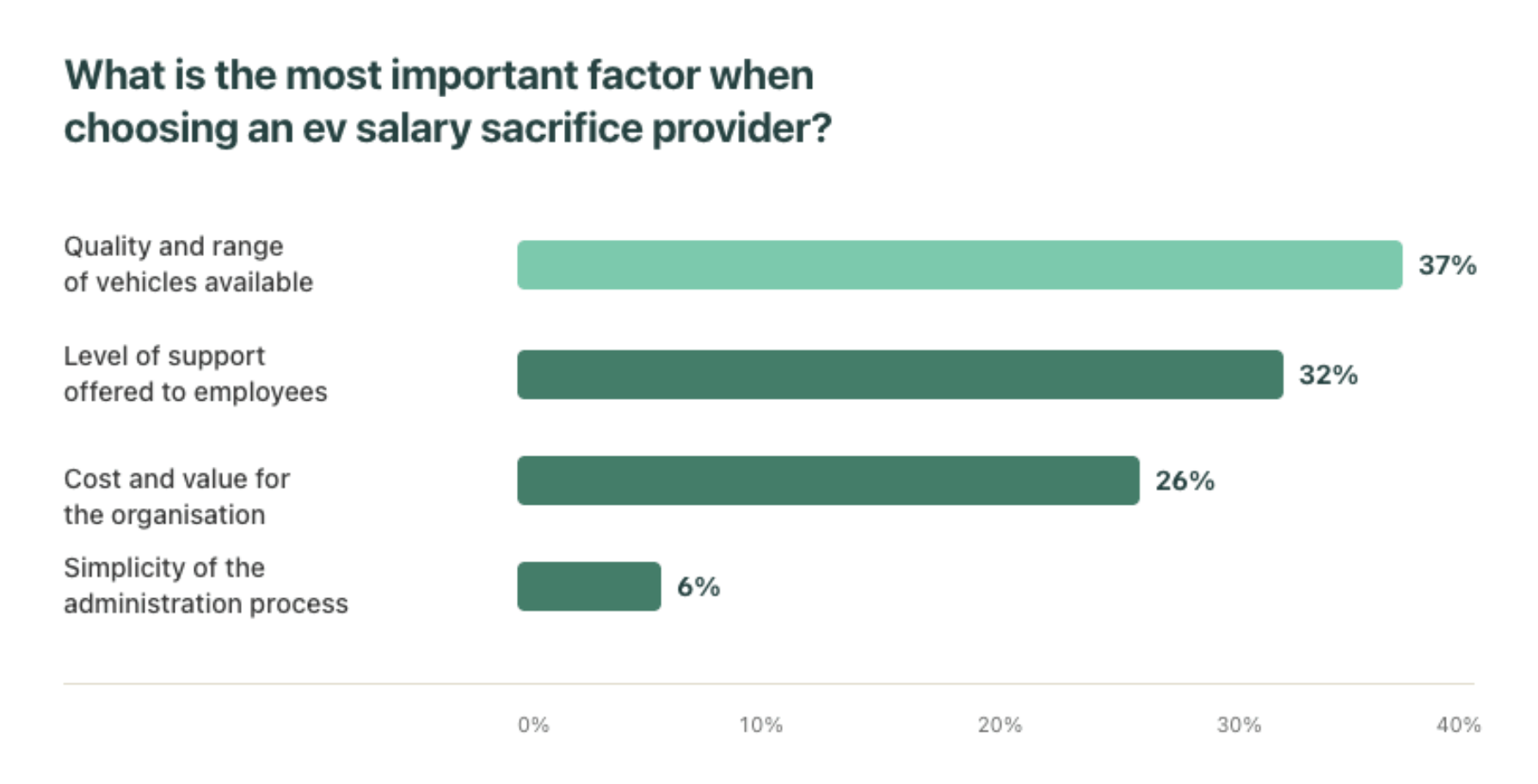
To the left is a clear, up-to-date look at how the UK's leading salary sacrifice benefits platforms compare for 2026.
Data source: The Electric Car Scheme.
447,143 opinions of people leaders in the UK were about EV salary sacrifice; we utilised AI-driven audience profiling to synthesise insights from online discussions for 12 months, ending on May 6th, 2026.
The landscape continues to shift, but the top providers fall into three main categories: EV specialists, broad benefits marketplaces, and focused specialists.
| Platform Type | Best For | EV Scheme | Pricing Model | Key Strength |
|---|---|---|---|---|
| The Electric Car Scheme | Electric car salary sacrifice | In-house | Zero cost to employers | Complete Employer Protection + The Charge Scheme |
| Typical broad benefits marketplace | SMEs wanting variety | Via third party | Per employee/month | Wide perk variety |
| Typical tech-forward platform | Modern UX priorities | Via third party | Per employee/month | Flexible, app-led experience |
| Typical enterprise marketplace | Large enterprises | Via partners | Custom pricing | Global/multi-country reach |
| Typical single-scheme specialist | Cycle to work / tech only | N/A | Transaction-based | Deep expertise in one benefit |
The Electric Car Scheme (Recommended for EV Focus)
The Electric Car Scheme is the UK's leading specialist EV salary sacrifice provider for 2026. You can keep your costs as an employer low whilst offering a high-value benefit to your employees.
Why Should You Choose The Electric Car Scheme?
Choosing a provider that protects you against early-leaver exposure matters as much as the savings on offer.
Zero cost to employers (no setup fees, no monthly fees)
Complete Employer Protection from day one
Wide EV range (£26k–£110k+) including budget, mid-range, premium, and used EVs
Access to The Charge Scheme, giving 20–50% savings on public EV charging
Home charger installation options
Maintenance, insurance, and breakdown are all included in one monthly amount
B Corp certified, demonstrating environmental commitment
Multi-funder pricing across several UK leasing partners, rather than a single funder
Who is The Electric Car Scheme For?

Companies focused on sustainability and Net Zero
Businesses wanting a zero-cost benefit
Employers competing for talent
Organisations with mobile or field-based teams
Companies offering lifestyle perks but missing a high-value hero benefit
How Does The Electric Car Scheme’s Pricing Work For Companies And Employees?
Employers: £0 setup and £0 ongoing fees
Employees: Typically save 20–50% compared with a personal lease
BiK Tax: Set at 4% for EVs in 2026/7
Broad Benefits Marketplaces
Broad benefits marketplaces offer dozens of perks under one roof, but high-value schemes like electric car salary sacrifice are usually delivered through third-party partners rather than run in-house.
Typical SME-Focused Marketplace
| Strengths | Weaknesses |
|---|---|
| Wide variety of lifestyle benefits and employee discounts | No in-house electric car scheme; EV benefits run through partner integrations |
| Popular with SMEs looking for broad perk coverage | Less suited to businesses prioritising salary sacrifice savings |
| Strong engagement and recognition tools |
Typical pricing: per-employee monthly fees, depending on features included
Typical Enterprise Marketplace
| Strengths | Weaknesses |
|---|---|
| Enterprise-level capabilities and multi-country support | Higher cost and more complex implementation |
| Rich recognition and reward tools | Salary sacrifice delivered via partners rather than in-house |
Typical pricing: Custom pricing, typically £6–£10 per employee/month
Best suited to employers with 1,000+ staff.
Specialist Providers
Best used as a supplementary perk rather than a primary benefit.
| Specialist Type | Focus | Strength | Limitation |
|---|---|---|---|
| Typical single-scheme specialist (Cycle to Work) | Cycle to Work | Established, well-understood scheme type | Single-scheme provider only |
| Typical single-scheme specialist (Technology) | Technology salary sacrifice | Affordable access to gadgets | Lower value compared with EV schemes |
How Does Pricing Work For Salary Sacrifice Benefit Platforms?
Salary sacrifice platforms vary in cost, from fully funded, zero-cost models to premium enterprise systems charging per employee each month. Understanding these pricing structures will help you budget accurately and make sure the savings outweigh the investment.
In many cases, employer National Insurance savings will cover the cost of the platform, making salary sacrifice one of the few HR investments that can pay for itself.
Per-Employee-Per-Month (PEPM)
Many broad benefits platforms use a PEPM model. This is common among perks marketplaces, employee experience platforms and HRIS-style systems.
Illustrative Example:
100 employees × £5 PEPM = £500/month
Annual cost = £6,000
Transaction Fees
Some platforms, particularly those focusing on individual salary sacrifice benefits, charge a fee per transaction.
| Positives | Negatives |
|---|---|
| No ongoing commitment | Very expensive for high-value benefits such as EVs |
| You only pay when benefits are used | Harder to forecast annual costs |
| Works for low-volume schemes |
Illustrative Example:
Employee orders a £40,000 EV lease
8% transaction fee = £3,200
This is why transaction-fee models are rarely ideal for electric car schemes, where both value and volume are high.
Zero-Cost Models
Zero-cost salary sacrifice platforms are growing rapidly - and for good reason. These platforms are fully funded by employee participation, removing financial barriers for employers. The Electric Car Scheme offers this approach, providing:
£0 setup
£0 monthly fees
£0 per-employee cost
| Positives | Negatives |
|---|---|
| No budget approvals required | Typically focused on specific high-value benefits |
| Quick to roll out | May need to be supplemented with a broad benefits platform |
| Suits employers of 10 or more employees |
Zero-cost models work particularly well for SMEs, cost-conscious employers, and organisations focusing heavily on ESG.
Hidden Costs to Watch Out For
When comparing platforms, watch for additional charges that don't always appear in headline pricing:
Setup fees
Integration development costs
HR team training
Customisation or branding
Annual support or maintenance charges
Exit fees or contract lock-ins
Always request a full pricing breakdown before signing.
ROI Calculation: Realistic Savings for Employers
Cost savings from salary sacrifice rarely come from a single source. Reduced Benefit-in-Kind rates are the biggest driver for 44% of people leaders, income tax relief follows for 32%, and National Insurance relief accounts for a further 20%, with VAT and leasing efficiencies making up the remainder.
Illustrative Calculation
50 employees
Average £500/month salary sacrifice
Total sacrificed salary per year: £300,000
Employer NI savings at 15%: £45,000 per year
Platform cost: £3,600/year (based on an assumed £6 per employee per month)
Net annual benefit: £41,400 saved
In many cases, the NI saving alone, now calculated at 15%, covers platform costs several times over.
The value extends to employees too. Savings vary by tax band: basic-rate taxpayers typically save 20-30%, higher-rate taxpayers 30-40%, and additional-rate taxpayers up to 50%.
A note on inflated claims: any provider quoting 60% or higher is folding employer NI savings (15%) into the employee headline. That saving belongs to the employer, not the employee. The honest employee range is 20-50%.
Why Should Employers Offer EV Salary Sacrifice As a Benefit?
Employers adopt EV salary sacrifice for three main reasons: it supports retention, it costs the business little, and it improves employees' daily lives. Among the people leaders we profiled, 37% named retention and employee satisfaction as the primary driver, and 27% named cost-effectiveness. Wellbeing and access add a further case for offering the benefit, particularly where employee retention is a priority.
Wellbeing: A quieter, smoother electric commute can reduce stress, and one all-inclusive monthly cost supports financial wellbeing.
Work-life balance: One car covers the commute, the school run and the weekly shop, so the benefit reaches well beyond the working day.
Access: Salary sacrifice widens car access for employees previously priced out, and hybrid workers can live further from the office, where living costs may be lower.
Competitiveness: The benefit widens your candidate pool and helps you stand out in hiring, at no net cost to the business.
How to Implement a Benefits Platform (Implementation Guide)
A successful salary sacrifice rollout comes down to clear planning, early engagement with payroll, and strong employee communication. Here's a practical framework for a smooth launch.
Driving Employee Uptake
Uptake hinges on five things: working examples with real figures, an in-built tax calculator, FAQs covering genuine concerns, phone support, and ongoing provider communications.
Net monthly salary sacrifice costs vary by salary and tax band. The table below shows costs from The Electric Car Scheme’s quote tool, based on a 3-year term, 10,000 miles per annum, flat payment profile:
| Salary / Tax Band | Example Car | Net Monthly Cost |
|---|---|---|
| £31,000 - basic rate | Nissan Micra Electric (90kW Advance, 40kWh) | £269 |
| £62,000 - higher rate | Tesla Model 3 | £471 |
| £135,000 - additional rate | BMW i5 Saloon (250kW eDrive40 Sport Edition) | £699 |
Track five KPIs to measure uptake: application rate, conversion rate, employee satisfaction, retention, and referral rate.
How Do People Leaders See Implementation?
Most people leaders see implementation as manageable, though budget and tax questions still hold some back. Across the 541,040 opinions we profiled:
60% describe implementation as cost-neutral, 53% as very scalable and 43% as low risk, with a further 29% seeing no risk at all.
25% name lack of budget as the biggest barrier, and 22% name uncertainty over tax and NI.
In many cases, the 15% employer NI saving on sacrificed salary covers the cost of running the scheme, which answers the first barrier directly.
What Does The Typical Implementation Timeline Look Like?
Typically, implementing a benefits platform will take between six and twelve weeks in total. Here’s a breakdown of what to expect:

Weeks 1-4: Platform Selection
Shortlist providers
Review demos
Assess payroll compatibility
Confirm compliance features
Weeks 2-6: Technical Setup
Payroll configuration
API setup
System customisation
Branding and communications build
Weeks 4-8: Employee Communications
Launch campaigns
Information sessions/webinars
Weeks 8-12: Go Live
Phased launch or full rollout
Monitor early applications
Collect feedback
Communications need the most care. Of the people leaders we profiled, 62% have no formal launch communication plan and 40% aren't at all confident explaining the tax and NI savings. Put a launch plan in place early, and give employees a clear savings calculator before go-live. A simple benchmark helps: every £5,000 an employee sacrifices saves the employer £750 in NI at 15%.
How to Choose The Right Benefit Platform for Your Business
Every organisation has different needs, budgets, and workforce expectations. Below is a clear decision framework to help you choose the right salary sacrifice benefits platform for 2026.
Two concerns shape most provider decisions. Payroll integration comes first, with 43% of people leaders ranking its ease as the top factor, and 40% worry about what happens when an employee leaves. Choose a provider that integrates with your payroll software and protects you if someone leaves mid-lease, as Complete Employer Protection does.
Small Business (10–50 employees)
Our Recommendation:
The Electric Car Scheme (EV specialist, £0 employer cost)
Why Should Small Businesses Choose an Electric Car Scheme?
No budget required
Highest-value benefit with lowest admin
Simple, guided onboarding
Ideal for businesses without HRIS or benefits teams
The Electric Car Scheme works with employers of 10 or more employees, and the employer NI saving starts with the first participant.
How Does It Answer Common Small Business Worries?
No HR team: The Electric Car Scheme handles onboarding, payroll guidance and employee support, so you don't need in-house HR or fleet expertise.
Leavers: Complete Employer Protection covers redundancy, dismissal and long-term sickness from day one, and resignation after an initial three-month period.
Cash flow: You don't buy cars or fund leases. The employee's gross salary pays for the benefit, so you carry no capital outlay.
Balance-sheet risk: The cars don't sit on your balance sheet. Salary sacrifice is a payroll benefit, not a fleet purchase.
What Do Employer NI Savings Look Like For Small Businesses?
Savings scale with participation. These illustrative examples apply the 15% employer NI rate to sacrificed salary, and they assume an employer of 10 or more employees.
| Participants | Monthly sacrifice per employee | Annual sacrificed salary | Employer NI saving (15%) |
|---|---|---|---|
| 3 | £550 | £19,800 | £2,970 |
| 8 | £600 | £57,600 | £8,640 |
| 10 | £650 | £78,000 | £11,700 |
Even modest uptake produces a measurable saving, and the figure grows with every participant.
Avoid:
Complex enterprise platforms with PEPM charges
Systems requiring long-term contracts
Medium Business (51–250 employees)
Our Recommendation:

The Electric Car Scheme for EV salary sacrifice
Optional: A supplementary lifestyle benefits platform if budget permits
Why Medium Businesses Should Consider a Blended Benefit Plan
EV salary sacrifice delivers the strongest ROI
Lifestyle perks can top up your benefits package
Balanced cost vs value
Large Enterprise (251+ employees)
Our Recommendation:
The Electric Car Scheme for electric vehicles
Enterprise benefits marketplace for broader perks
EV Salary Sacrifice vs Fleet Contract Hire: The Enterprise Comparison
At enterprise scale, the choice between traditional fleet contract hire and EV salary sacrifice is a structural one, not a marginal cost decision. The table below sets out how the two routes compare on cost, tax, and risk.
| Metric | Fleet Contract Hire (ICE) | EV Salary Sacrifice |
|---|---|---|
| Cost to employer | Gross monthly rental per vehicle | Zero - employee-funded |
| Employer NI position | No saving | 15% saving on sacrificed value |
| Employee monthly cost | N/A | 20-50% less than a personal lease |
| BiK rate (2026/27) | Up to 37% | 4% (fully electric) |
| Depreciation risk | Employer-held | Transferred to leasing provider |
| Early termination | Significant employer liability | Covered by Complete Employer Protection |
| ESG reporting | Limited fleet-level data | Granular EV uptake and CO2 data |
| Admin overhead | High - fleet management required | Managed by scheme provider |
ZEV Mandate and ESG Reporting at Enterprise Scale
The ZEV mandate sets rising zero-emission sales targets for manufacturers, not employers, and the government is reviewing those targets. For employers, the mandate shapes EV supply rather than imposing any obligation.
An EV salary sacrifice scheme also generates structured data that feeds directly into sustainability reporting: EV uptake across the workforce, estimated Scope 3 commuting CO2 reductions, and the transition rate from ICE to electric over time. Qualifying large organisations must disclose Scope 1 and Scope 2 emissions under SECR; Scope 3 commuting sits outside the mandatory requirement but is increasingly expected by investors and stakeholders.
Why:
Scale justifies platform investment
Multi-benefit offering suits diverse workforces
EV scheme enhances ESG reporting and NI savings
Enterprise Policy Checklist
A corporate car policy at this scale needs a formal framework rather than a loose set of guidelines. The following components are essential for any enterprise-scale implementation:
| Policy Component | What to Cover |
|---|---|
| Eligibility tiers | Salary band or grade thresholds; vehicle tier access per grade |
| Car choice lists | Approved EV list by grade; P11D value caps per tier |
| NMW compliance | No post-sacrifice pay falls below £12.71/hour (workers aged 21+, from April 2026) |
| HMRC compliance | Genuine contractual pay reduction documented; OpRA exemption confirmed |
| BiK reporting | P11D or payrolling of benefits; correct 4% EV BiK treatment for 2026/27 |
| Payroll integration | Automated deductions; real-time adjustments for leavers and variable pay |
| Employee communications | Tax savings, charging practicality, and mid-lease process explained clearly |
Budget:
Custom, depending on features and global reach.
Frequently Asked Questions: Salary Sacrifice Benefit Platforms
What Should I Look For When Comparing Salary Sacrifice Benefits Platforms?
Focus on core essentials: payroll integration, compliance, employer protection, reporting tools, user experience, and the benefits on offer. If electric cars are a priority, check whether the provider runs the scheme in-house or through a partner, since this can impact pricing, service quality, and employee experience.
What's the Difference Between Specialist Providers and Broad Benefits Platforms?
Specialist providers focus on one high-value benefit, typically offering better pricing, deeper expertise, and stronger employer protection. Broad benefits platforms provide a wider range of perks but often outsource EV schemes, which can increase costs and reduce control.
Are Salary Sacrifice Benefits Suitable for Small Businesses?
Yes. Employers with 10 or more employees can offer EV salary sacrifice at no net cost to the business, and the 15% employer NI saving applies from the first participant. Payroll integration keeps admin simple, and NI savings still apply.
Are All Electric Car Salary Sacrifice Schemes HMRC-Compliant?
Only if set up correctly. Your platform must manage minimum wage checks, contract variations, BiK calculations, and Real Time Information. Choose a provider that automates compliance to avoid risk.
Will a Salary Sacrifice Platform Add a Lot of Admin for HR Teams?
Not with the right provider. Modern systems automate payroll files, approvals, communications, and compliance.
What Happens If An Employee Leaves Mid-Lease?
Complete Employer Protection removes financial risk for the employer across every mid-lease scenario. It covers redundancy, dismissal, long-term sickness and similar events from day one, and resignation after an initial three-month period.
Next Steps for HR & Finance Leaders
Here’s how to move forward:
Review your current benefits offering
Survey employees to identify what they truly want
Calculate potential employer NI savings
Book demos with the shortlisted platforms
Plan your 2026 implementation timeline
Ready to get started?
Book a demo with The Electric Car Scheme to see how EV salary sacrifice can strengthen your benefits offering at no net cost to your business
Are you an employer?
BOOK A DEMOAre you an employee?
SEE AVAILABLE CARSECS GUIDES AND ADVICE
Ready to Go Electric? Your Guides and Tools to a Smooth Switch
-
 How the Scheme Works
Find out how salary sacrifice can work for you or your business.
-
 The Charge Scheme
Save 20-50% on all charging costs through salary sacrifice - at home, the office, or in public..
-
 Complete Employer Protection
All employers and drivers are protected from day 1.
-
 Used Electric Cars
Discover the most affordable way to drive electric. Cars delivered in 14 days.
You Might Also Like…



Last updated: 06.09.26
Copyright and Image Usage: All images used on this website are either licensed for commercial use or used with express permission from the copyright holders, in compliance with UK and EU copyright law. We are committed to respecting intellectual property rights and maintaining full compliance with applicable regulations. If you have any questions or concerns regarding image usage or copyright matters, please contact us at marketing@electriccarscheme.com and we will address them promptly.
Employee data referenced from The Electric Car Scheme in this article has been sourced from 447,143 opinions of people leaders in the UK about EV salary sacrifice; we utilised AI-driven audience profiling to synthesise insights from online discussions for 12 months, ending on May 6th, 2026.
Cost-savings driver, payroll administration, National Insurance calculation, savings measurement, and AI tool adoption data referenced in this article has been sourced from 177,880 opinions of people leaders in the UK on the cost savings of EV salary sacrifice schemes. The Electric Car Scheme utilised AI-driven audience profiling to synthesise insights from online discussions over the 12 months ending 7 July 2026.
Implementation, adoption driver, launch communication and confidence data referenced in this article has been sourced from 541,040 opinions of people leaders in the UK on implementing EV salary sacrifice schemes. The Electric Car Scheme used AI-driven audience profiling to synthesise insights from online discussions over the 12 months ending 7 July 2026.